imessage group chat sms fallback
By Beam team · Updated
Why Group iMessage Drops to Plain SMS Mid-Thread
One non-iMessage contact flips a whole group thread to SMS, killing attachments and unified replies. Here is how to catch it before your agent sends.
Beam is an independent messaging platform, not an Anthropic or Apple product.
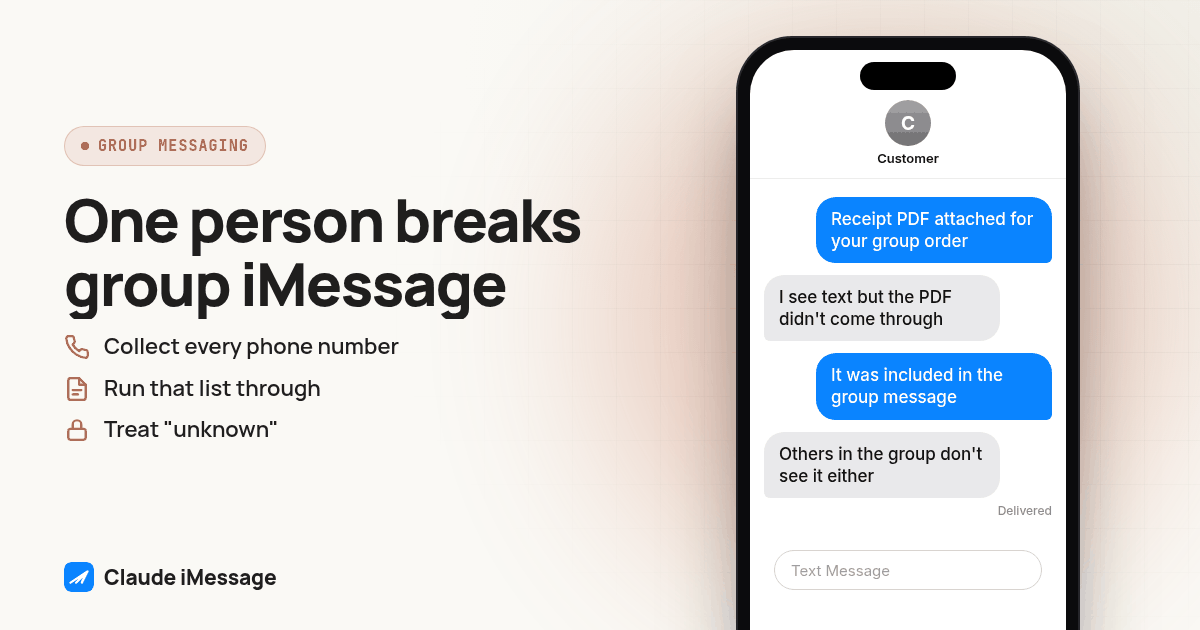
Why does one non-iMessage contact flip the whole group to SMS?
TL;DR: A group iMessage thread only stays blue if every participant is reachable on iMessage. The moment one person is not, Apple quietly drops the entire conversation to SMS or MMS for everyone, not just the one holdout, and attachments, unified replies and group naming all go with it. Your Claude built agent has no way to know this happened unless you check each participant's service before you build the thread, which is what we walk through below.
We build and run Claude based iMessage agents for a living, and the group fallback is one of the first "it worked yesterday" bugs a builder hits once real contacts get added to a thread. Someone's cousin has an Android phone, or a teammate switched carriers last week and has not re registered, and the whole group that used to carry photos and replies cleanly now behaves like an old style text thread. Nothing in the agent's code changed. Apple's rule did not change either. The thread simply never qualified for iMessage, and nobody checked.
One scope note: Beam builds the messaging layer a Claude agent uses to send and receive iMessage, and this article explains an Apple level rule, not a Beam or Anthropic rule. Beam is independent of both companies. We are describing what Apple already documents and showing where to put a check for it in your agent's send path.
Apple's own support page is direct about this: a group message only goes out as iMessage "if all of the recipients are using Apple devices and iMessage is turned on." If even one recipient is not reachable, "the message is sent as an MMS or SMS" (Apple support). That is a group level switch, not a per person one. The group does not split into iMessage for the capable people and SMS for the one holdout. The whole conversation, every bubble, every participant, moves together.
This catches builders off guard because one to one chats behave differently. A single conversation with a non-iMessage contact just becomes a green thread for that one person, and nothing else changes. Groups work differently because an iMessage group is a single shared conversation object on Apple's servers, built so everyone sees the same thread, name and photo. SMS and MMS groups on carrier networks do not have that shared object; they behave closer to a list of near identical messages sent to each participant separately, which is why the experience falls apart once the switch happens.
What exactly breaks once the thread becomes SMS or MMS?
Three things go first, and an agent built and tested only against a clean iMessage group will hit all three without warning.
Group SMS "don't support multimedia attachments," per Apple, while MMS carries media with far looser reliability than iMessage (Apple support). An agent sending a photo receipt or a PDF confirmation into a blue group will have that file silently dropped or refused, with nothing telling it why. We cover the two real paths for sending a native attachment, and the size and file type ceiling each carries, in our attachment guide for Claude iMessage agents; both assume the conversation underneath is still iMessage.
Replies stop being shared. Apple states it plainly: "all responses in a group SMS are sent as individual text messages and the recipients can't see the other responses from the group" (Apple support). For a person this is annoying. For an agent reading a group conversation and replying with context, it is worse: the agent may only see the slice that routes back to its own line, and will reply into a thread other participants cannot see either, splintering the group into side conversations nobody can reconcile.
Group identity disappears too. Naming the group and setting a group photo do not carry over once the conversation is MMS, and some carrier combinations will not let you add a new participant to an existing SMS thread. From your agent's send call, the difference is simple: a clean iMessage group is one conversation to track, while a mixed group behaves like several conversations with inconsistent delivery per recipient.
Why does this failure mode hit an AI agent harder than a person?
A person notices the bubble color. They see green instead of blue, see the photo did not go through, and text that one person separately. An agent does not have eyes on the thread the way a person does. It has whatever its send call returns, and a send call reporting queued or accepted does not say which protocol carried the message. We cover that exact gap, and what a delivered confirmation can and cannot tell an agent, in our piece on what a Claude iMessage agent can actually confirm about delivery: a 200 response means the message was queued, nothing more, and the service it rode on is a separate fact the agent has to go find.
Stack that blind spot on the group fallback problem and you get a repeatable failure: the agent keeps calling its normal send function, keeps getting an accepted response, keeps attaching files the way it always has, and the only signal anything changed is a person asking where the attachment went. By the time that complaint reaches you, the agent may have dropped files for days. This is the exact failure a public pull request on a community maintained iMessage connector project set out to fix: the change makes the send function inspect a conversation's services before queuing anything, refusing outright rather than deferring the rejection downstream (GitHub pull request). Shipping this as a dedicated fix, with its own test coverage, is a good sign the problem is common enough to guard against on purpose.
How do we check a group's status before the agent sends anything?
Move the check earlier, from finding out after someone complains to finding out before the thread exists. Here is the sequence we use:
- Collect every phone number or Apple ID handle planned for the group, before creating anything.
- Run that list through a reachability check that returns a per number verdict, not one pass or fail for the batch, tagging each number iMessage capable, text only, invalid, or unknown.
- Treat "unknown" as unresolved, not a quiet pass; an unconfirmed number is not the same as one confirmed text only.
- If every participant comes back iMessage capable, create the group and proceed.
- If one or more come back text only or invalid, stop before creating a shared thread, and decide whether the group proceeds as SMS or that participant gets handled on a separate line.
- Log the verdict against the group so your team can see later why a thread is blue or green.
- Re check periodically, since people change phones and carriers and a group that passed last month is not guaranteed to still be clean today.
The same logic applies if you drive Messages directly on a Mac instead of a hosted API, just read from a different source. Apple's own guide for forwarding texts to a Mac confirms at least one address in a conversation has to be registered with iMessage before that conversation can appear there as iMessage at all (Apple support). A script driving Messages.app can read a conversation's service type the same way the pull request above does, by checking the record before sending rather than trusting the last bubble color.
Here is the shape of that check as pseudocode, close to what we wire into an agent's send path:
for each participant in group:
    status = screen(participant.number)
    if status in ("text_only", "invalid"):
        mixed_service = true
    if status == "unknown":
        unresolved = true

if mixed_service or unresolved:
    hold_send()
    notify_owner("group will fall back: " + participant.number)
else:
    create_group_and_send()
That is the whole pattern. The expensive part is remembering to call it before the thread exists, not after.
What should the agent do when it finds a mixed-service group?
Refuse the silent degrade, then hand a real choice to whoever runs the agent instead of making it for them. We favor three responses, picked by what the group actually needs.
Warn and hold fits an optional group, such as a project thread where attachments matter. The agent stops before creating the thread and tells a person which participant broke the check, so a human decides whether to proceed anyway or swap that contact out.
Fan out to one to one fits content that matters more than one shared thread, such as the same confirmation going to several people who do not need to see each other's replies. The agent sends individually to each capable participant and separately to the text only one, preserving attachments for everyone who can receive them.
Accept and adjust fits a group that must include someone without iMessage, such as a family list with a relative on an older phone. A family style assistant handles this today by keeping one shared line that the whole household saves as a single contact, so the list stays current regardless of which device last answered.
Business teams face the same decision, and Beam's own documentation on group messaging does not pretend a shared multi person business thread is solved either; it explains why a one lead, one thread model sidesteps the fragility entirely, see Beam's explainer on group iMessage for business teams.
How do we test this before pointing the agent at real contacts?
Do not find out about the fallback from a real group. Build a small test matrix first.
- Create a test group with every participant confirmed iMessage capable, and confirm the agent's send, attachment and reply handling work end to end.
- Add one test participant who is deliberately text only, using a second device or test number you control, and repeat the same send sequence.
- Confirm the reachability check flags that participant before the group is created, not after a failed send.
- Send an attachment into the now mixed group on purpose, and see the degraded delivery yourself.
- Remove the text only participant, start a fresh thread with only capable participants, and confirm the group returns to full iMessage behavior, proving the fallback tracks who is in the room, not the thread itself.
- Write down what the agent does in each state so the behavior is a documented choice rather than whatever ran first.
Screenshot: side by side Messages.app threads with the same two participants. The left thread shows a blue header with a delivered photo thumbnail; the right shows a green "Text Message" header with the same photo collapsed to a broken file icon.
Diagram: the agent's send path as three boxes in sequence, collect participants, screen each number, branch on the result, with the branch splitting into create and send, hold and notify, or re check before proceeding.
You cannot change what Apple requires for a thread to stay blue, but you can make sure your agent finds out the truth about a group before a person has to tell it. Screening the roster before the thread exists, instead of after someone notices a missing file, is the difference between a Claude agent that looks unreliable in exactly the threads that matter most and one that quietly makes the right call every time. Start with the Claude iMessage overview if you are still deciding which path, hosted or self hosted, fits how your agent needs to run.
Before you connect
What do teams ask before they connect?
How do I know a group thread has already fallen back to SMS?
Open the thread on a Mac or iPhone and look at the header and bubble color. A blue header and blue bubbles mean the group is still on iMessage. A green header, or a header that just shows phone numbers with no group photo option, means the thread is already SMS or MMS. If you send through a hosted API instead of a Mac, check the per recipient status field on your last send rather than trusting a generic success response.
Can I push a non-iMessage contact back onto iMessage to fix an existing group?
No, not from your side and not from inside the thread. The missing person has to turn on iMessage on their own device with their own Apple ID. Once they do, a brand new group created from that point forward can be blue, but the old thread on everyone's phone usually stays the way it started. Plan on starting a fresh thread rather than waiting for an existing SMS group to upgrade itself.
Does the same problem happen in a one to one conversation, not just a group?
A one to one conversation degrades the same way for that single contact, but it does not spread. Text one non-iMessage person directly and only that thread becomes SMS. In a group, that same one person drags every other participant's copy of the conversation down with them, even the ones who are fully capable of iMessage.
If I switch my agent from a local Mac setup to a hosted messaging API, does that fix the fallback?
It does not remove the underlying rule, because that rule belongs to Apple, not to whichever tool sends the message. What a hosted API can give you that a bare Mac script usually cannot is a way to check a whole contact list's reachability before you ever create the thread, so you find the mismatch during setup instead of after someone asks where the photo went.
What is the fastest fix once we discover a group has already dropped to SMS?
Do not keep fighting the existing thread. Pull the roster, confirm who is actually iMessage capable right now, and start a new group with just those people if a true blue thread matters. Keep the non-capable person on a separate one to one line, send attachments as a link instead of a native file, and accept that their replies will arrive outside the group view until they switch.
Keep exploring