Quick answer: iMessage’s end-to-end encryption covers the hop between the sending device and the receiving device; it says nothing about the sending platform in between. A hosted iMessage API like Beam composes and queues the message, which means the plain text exists on that platform’s infrastructure for a moment, and that same moment is what lets the platform hand an agency a conversation history and webhook feed to build its own compliance record. Apple does not publish a compliance API, so the agency’s own logging, not a request to Apple, is the only real source of record retention. For the full compliance picture, see Beam’s texting compliance hub.
A law firm, a medical practice, or a financial services team asking whether iMessage is encrypted is really asking a narrower question: can we text clients on a blue bubble and still meet our own record-keeping rules. Encryption and record retention are two different systems. iMessage’s encryption protects the message in transit; an agency’s compliance obligation is what gets logged before that hop starts, and only the business itself will keep that record.
Where does iMessage’s end-to-end encryption actually apply?
Apple’s privacy documentation is specific about this: “iMessage is end-to-end encrypted,” and Apple designed it so that “there’s no way for Apple to decrypt the content of your conversations when they are in transit between devices” (Apple, Messages privacy). Attachments get the same treatment, encrypted so only the sender and receiver can open them. That is a genuine, specific claim about one link in the chain: the transmission between the sending and receiving device.
The same page is just as specific about what sits outside that claim. Apple retains limited information about iMessage use, “such as whether your device is eligible to use iMessage,” and messages backed up through iCloud Backup or Messages in iCloud get their own encryption treatment, separate from the in-transit protection. None of that contradicts the end-to-end claim; it shows that encryption is a precise, narrow guarantee about one hop, not a blanket statement that no copy of a conversation exists elsewhere in the system.
Where does a hosted sending platform sit inside that chain?
This is the part buyers researching “is iMessage encrypted” rarely ask next, and it is what actually matters for a compliance program. A hosted iMessage API sits in front of the device-to-device hop Apple describes, composing and queuing the message before handing it to Apple’s transport.
A hosted provider’s own technical explanation puts it plainly: when a business sends through a platform like this, “your message is composed and sent on a device the provider controls,” so “the plaintext necessarily exists on the provider’s infrastructure before it is handed to Apple’s encrypted transport” (hosted iMessage provider’s encryption explainer). The same source is explicit: “end-to-end encryption does not mean the provider never handles the content.” That is not a flaw unique to one vendor; it is how the category works, since Apple has never published an official API for third-party iMessage sending.
Beam’s own setup matches that shape: dedicated business lines send and receive iMessage through a workspace API, not a personal Apple ID or a phone left running in a closet. A client conversation’s plain text passes through the sending platform as part of delivering the message, read receipts, and replies, and that same fact is what lets the platform hand the business a usable record.
What does “message content logged for compliance” actually look like in practice?
For an agency building its own record-retention process, the useful question is not whether a vendor can see a message in the abstract, but whether the business can pull a complete, accurate copy of every sent and received message into a system it controls. On Beam, that record exists in two forms that work together.
The first is on-demand conversation history: a request to a contact’s conversation endpoint returns the full thread, including sender type (a human seat, the AI assistant, or the system), channel, message body, and a timestamp for each entry (Beam’s conversation history documentation). An agency can pull this on a schedule into its own archive, independent of whatever retention window the platform itself keeps.
The second is event-driven: signed webhooks fire for message.received, message.sent, and message.failed, each carrying the message body and channel the moment it happens (Beam’s event webhook documentation). A business that wants a near-real-time log captures these events and verifies the signature on each before writing it to storage. Either approach, run consistently, produces a record an auditor or a client’s counsel can review later. Skipping both and assuming “the platform has it somewhere” becomes a real problem the first time someone asks for a specific conversation from months ago.
Diagram: A client’s iPhone connects through an arrow labeled “end-to-end encrypted” to a business line icon, which branches to a server icon labeled “agency’s own archive (conversation history pull + webhook capture),” showing the archive sits on the business side of the line, not inside Apple’s encrypted hop.
Why does Apple not just offer a compliance API for iMessage?
Because Apple’s whole design goal is that it cannot read the content, and a compliance API would require the opposite. One vendor working in the regulated-communications space states this directly: “Apple has no compliance API that exposes message content to third parties, meaning even Apple itself cannot hand over readable message content on request” (Archon Data Store, iMessage compliance). That matches Apple’s own privacy page: a regulated business cannot plan around someday asking Apple for a transcript. The record has to exist on the business’s own side before the question comes up.
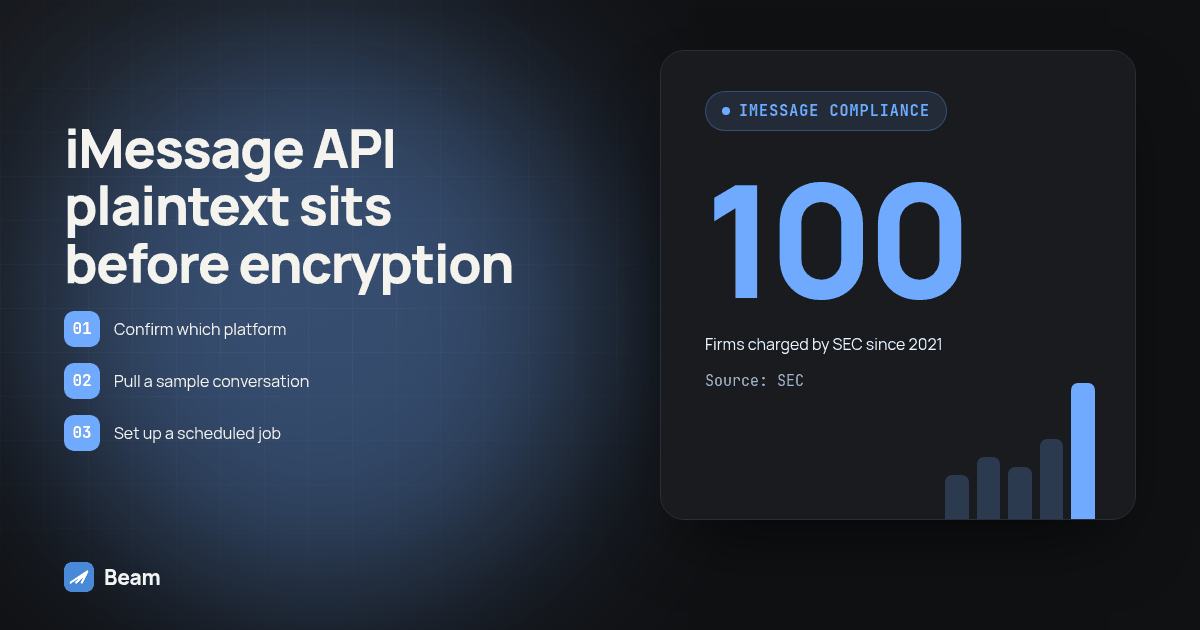
The same source is specific about what will not substitute for a real archive: “iCloud backups and screenshots are insufficient for compliance because they do not provide continuous capture, complete metadata, tamper-evident preservation, or reliable search.” A team that assumes a phone backup or a screenshot folder counts as a record often discovers otherwise only during an audit. The SEC’s September 2024 summary said that since December 2021 its recordkeeping initiative had charged more than 100 firms and obtained more than two billion dollars in penalties (SEC, 2024 recordkeeping enforcement summary). Those cases concerned failures to preserve business communications, including off-channel messaging. The figure is context about enforcement, not a prediction about any agency’s exposure.
How does this compare to SMS and RCS logging?
SMS and RCS run through a different chain: both move through the carrier network rather than Apple’s device-to-device system, so the carrier keeps its own delivery and routing records. A business can sometimes request portions of that record, but does not own or control it the way it controls its own archive.
| What you want to know | iMessage (device to device) | iMessage through a hosted business API | SMS or RCS through a hosted business API |
|---|---|---|---|
| Encrypted on the final hop to the recipient | Yes, per Apple’s documentation | Yes, for that last hop | No; carrier-grade transport, not end-to-end encrypted |
| Plain text ever exists on a third party’s infrastructure | No third party in a device-to-device conversation | Yes, briefly, before Apple’s transport takes over | Yes, on the sending platform and in normal carrier handling |
| Who can produce a compliance record on request | Neither device owner has an API for this; Apple has none either | The business, via conversation history or webhook capture | The business, by the same method, plus whatever the carrier provides |
| Carrier registration rules apply | No | No | Yes, by number type (10DLC, toll-free, or short code) |
The practical difference is smaller than the encryption headlines suggest. In both cases the business needs its own archive, since neither Apple nor a carrier produces one after the fact. What differs is what rides alongside the record, like the carrier registration work that applies to SMS and RCS but not iMessage, covered in Beam’s TCPA texting rules guide.
How should a regulated agency actually set up record retention for iMessage?
Run this sequence before a single client conversation goes live on the channel, not after a regulator asks for a transcript.
- Confirm which platform composes and sends the message, and get a plain answer on whether content passes through that platform’s infrastructure before delivery. “It is end-to-end encrypted” is only a partial answer.
- Pull a sample conversation through the platform’s API and confirm the response includes sender type, channel, full message body, and a timestamp, not just delivery status.
- Set up a scheduled job that archives conversation history into storage the business controls, daily for most regulated work.
- Separately, subscribe to event webhooks for received and sent messages, verify the signature on each one, and write the payload to the same archive as a second capture path.
- Confirm the archive is tamper-evident and searchable, meaning a reviewer can find a specific conversation by contact and date without relying on a screenshot folder.
- Document who can access the archive and why, with the same access-control discipline a law firm or clinic applies to any other client record.
- Test the full loop on a contact the team controls: send a message, confirm it lands in both the pulled history and the webhook capture, and retrieve it by date later.
- Repeat the test after any platform update, since a silent field change in the API or webhook format is exactly the kind of gap that breaks retention until an audit finds it.
A clean pass on this checklist does not mean the agency is fully compliant; consent rules, content rules, and the client’s own regulatory obligations are separate questions, covered in more depth on Beam’s texting compliance hub. It does mean the agency has an actual answer, backed by a retrievable record, the next time someone asks what was said and when.
What about HIPAA specifically, if the client is a medical practice?
The encryption question and the HIPAA question are related but not identical. Beam supports HIPAA compliant texting through compliant carrier infrastructure, a different claim from the content and access rules a practice runs on its own, covered step by step in what actually makes texting HIPAA compliant. The record-retention setup above is a prerequisite either way: a practice cannot show it handled protected health information correctly in a thread it cannot produce.
What should an agency tell a skeptical client who asks whether iMessage is encrypted?
Give the honest, two-part answer. Yes, the device-to-device hop is end-to-end encrypted, exactly as Apple describes it. No, that protection does not cover the sending platform, which necessarily composes the message before the encrypted hop starts. What actually protects the client is not the encryption claim, but the agency’s own access controls, retention process, and written policy on who can read a thread and why.
For the broader comparison between data-handling layers in an AI-driven sales workflow, see MetaTechAi’s guide to AI sales architecture and data security layers.
None of this is legal advice. Have the business’s own counsel or compliance officer confirm which retention rules apply to a specific client relationship before building an archive around any single vendor’s API or webhook format.
What do compliance-focused buyers ask about iMessage encryption?
Is iMessage really end-to-end encrypted, or is that just marketing language?
It is real. Apple's privacy documentation states that iMessage is end-to-end encrypted and that Apple cannot decrypt a conversation's content while it is in transit between devices. That protection covers only the hop between the sending and receiving device, not what happens on either side of it, which is where a business sending platform sits.
Why do compliance teams still worry about iMessage if it is encrypted?
Because end-to-end encryption describes transit, not custody. A message sent through a hosted platform exists as plain text on that platform's infrastructure before Apple's encrypted transport takes over, the same way a message typed into the Messages app exists as plain text on the phone before it leaves. Encryption in transit and a vendor's ability to log content during composition are separate facts, and a regulated business needs an answer for both.
Does switching from SMS to iMessage change what our agency has to log for a regulated client?
It changes who logs it, not whether logging is required. SMS and RCS pass through a carrier network that keeps its own delivery records, which a business can sometimes request but does not fully control. A hosted iMessage platform instead gives the business a conversation history and webhook feed it can pull on demand. Either way, the compliance record has to come from a source the agency controls, not from assuming the channel keeps that record on its behalf.
If a client or a regulator asks for text records, can Apple or the carrier just hand them over?
Not for message content, and that is close to the point. Apple's architecture gives it no way to decrypt in-transit content, and a vendor comparing iMessage to compliance requirements has noted that Apple has no compliance API that exposes message content to third parties, so it cannot hand over readable content on request. That is exactly why the record has to live with the business before the fact, not get requested from Apple after it.
Is iMessage encrypted the same way as WhatsApp?
Both describe end-to-end encryption for the device-to-device hop, and neither company's description of that hop covers what a business sending platform does with a message before or after it. The useful comparison is not which app's encryption is stronger. It is which platform gives the business its own retrievable copy of what was sent and received, since that copy, not the encryption claim, satisfies a record-retention requirement.